The Golden Ratio: Nature's Secret Formula Explained
Introduction to the Golden Ratio
Mathematics is often perceived as a collection of rigid rules and abstract formulas, disconnected from the vibrant, chaotic beauty of the real world. However, nothing could be further from the truth. Hidden within the fabric of nature, art, and architecture lies a single, fascinating mathematical concept that bridges the gap between science and aesthetics: The Golden Ratio.
Often denoted by the Greek letter Phi (Φ), the Golden Ratio is approximately equal to 1.6180339887... It is an irrational number, meaning its decimal representation goes on forever without repeating. But what makes this number so special that it has captivated the minds of mathematicians, artists, architects, and scientists for over two millennia?
Understanding the Mathematics Behind Phi (Φ)
To truly appreciate the Golden Ratio, we must first understand how it is derived. Imagine a line segment divided into two parts: a longer part (a) and a shorter part (b). The Golden Ratio exists if the ratio of the entire line segment (a + b) to the longer part (a) is exactly the same as the ratio of the longer part (a) to the shorter part (b).
Mathematically, this is expressed as:
(a + b) / a = a / b = Φ ≈ 1.618
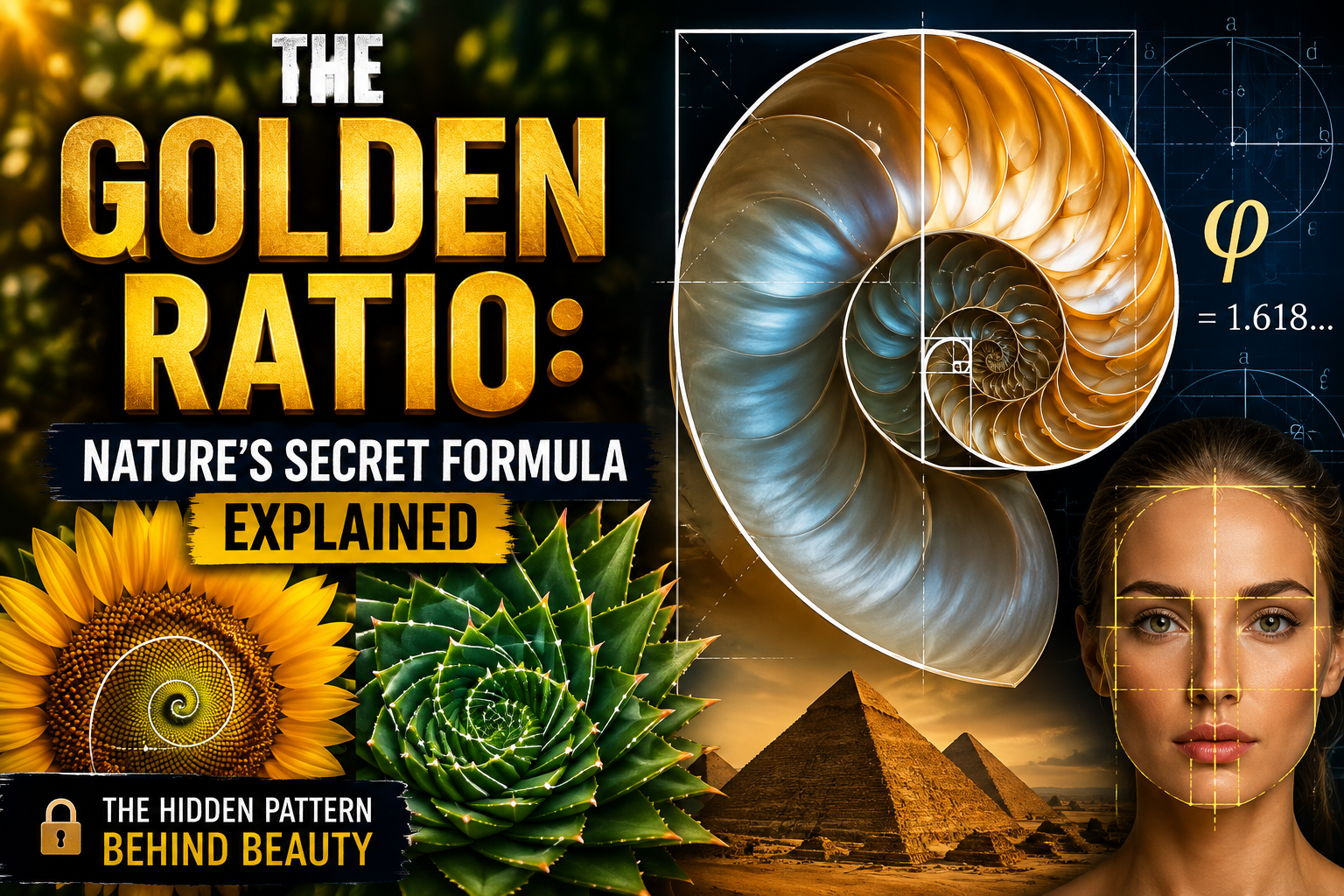
This simple yet profound equation gives birth to a self-replicating pattern. If you create a rectangle with side lengths proportional to the Golden Ratio (a Golden Rectangle), and you cut a square off one end, the remaining smaller rectangle will also be a Golden Rectangle. This process can be repeated infinitely, creating a spiral that shrinks endlessly inward—the famous Golden Spiral.
The Golden Ratio and the Fibonacci Sequence
The Golden Ratio is intimately connected to another famous mathematical concept: the Fibonacci Sequence. The sequence begins with 0 and 1, and each subsequent number is the sum of the two preceding ones: 0, 1, 1, 2, 3, 5, 8, 13, 21, 34, 55, and so on.
As you progress further down the Fibonacci sequence, the ratio between consecutive numbers (e.g., 55/34, 89/55) gets closer and closer to the Golden Ratio (1.618). This relationship is not just a mathematical coincidence; it is a fundamental law of nature.
The Golden Ratio in Nature
One of the most mind-boggling aspects of the Golden Ratio is its ubiquitous presence in the natural world. It seems as though nature itself uses this mathematical blueprint to design its creations.
- Flower Petals: The number of petals on a flower consistently follows the Fibonacci sequence. Lilies have 3 petals, buttercups have 5, chicory has 8, and daisies have 13, 21, or 34.
- Seed Heads: Look closely at the center of a sunflower. The seeds form intersecting spirals radiating from the center. Count the spirals curving to the left and those curving to the right, and you will almost always find two consecutive Fibonacci numbers (e.g., 34 and 55). This arrangement ensures maximum packing efficiency for the seeds.
- Pinecones and Pineapples: Similar spiral patterns are found on the bracts of pinecones and the hexagonal scales of pineapples, all adhering to the Golden Ratio.
- Nautilus Shells and Hurricanes: The mesmerizing, expanding shape of a nautilus shell is a nearly perfect Golden Spiral. The same logarithmic spiral can be seen in the formation of hurricanes and even in the sweeping arms of spiral galaxies like our Milky Way.
- The Human Body: Even the human body exhibits golden proportions. The ratio of your height to the distance from your navel to the floor is often close to 1.618. Similar ratios can be found in the lengths of the bones in your fingers and arms.
The Golden Ratio in Art and Architecture
Throughout history, humans have intuitively (and sometimes intentionally) incorporated the Golden Ratio into art and architecture, believing that this proportion creates the most aesthetically pleasing and harmonious compositions.
Ancient Architecture
The Great Pyramid of Giza in Egypt, constructed over 4,500 years ago, exhibits proportions closely related to the Golden Ratio. The ancient Greeks also revered this number. The Parthenon in Athens is widely believed to have been designed using Golden Rectangles, from its facade to the spacing of its columns. The sculptor Phidias, after whom the letter Phi is named, is said to have applied this ratio extensively in his work.
Renaissance Art
During the Renaissance, the Golden Ratio was known as the "Divine Proportion." Leonardo da Vinci, a master of both art and science, illustrated a book titled De Divina Proportione by mathematician Luca Pacioli. Da Vinci utilized the Golden Ratio in his legendary paintings, including The Last Supper and the enigmatic Mona Lisa, to create balanced and structurally sound compositions.
Modern Design
Even today, the Golden Ratio influences modern design. It is frequently used in graphic design, web layout, and typography. Many famous corporate logos, such as those of Apple, Twitter, and Pepsi, are reportedly based on golden proportions to ensure they are visually appealing and instantly memorable.
Is the Golden Ratio a Universal Rule?
While the Golden Ratio is undoubtedly fascinating, it is important to approach it with scientific objectivity. In recent years, some mathematicians and scientists have cautioned against "Phi-losophy"—the tendency to force the Golden Ratio onto things where it doesn't truly exist.
For example, while the nautilus shell is a logarithmic spiral, it is not always a perfect Golden Spiral. Similarly, not all beautiful art adheres strictly to this rule. Human perception of beauty is subjective and influenced by culture, symmetry, and context, not just a single number.
Conclusion: The Harmony of Mathematics
Whether you view the Golden Ratio as a universal law of beauty or an intriguing mathematical pattern that frequently appears in nature, its significance is undeniable. It serves as a beautiful reminder that mathematics is not just a tool for calculating bills or measuring distances; it is the underlying language of the universe.
The next time you look at a blooming sunflower, admire a historical monument, or simply look at the proportions of your own hand, remember that you are witnessing the elegant harmony of mathematics. The Golden Ratio, Phi, continues to inspire curiosity, proving that the world around us is
deeply and beautifully mathematical.